
Skip to content
Kangaroo Direct Publishing — home

Case studies

Three books, taken apart

What the brief was, which decisions mattered, where the production got difficult and what was delivered. No sales figures, because those are not ours to publish.

In detail

The work, in detail

Each of these had a constraint that shaped everything else: a page budget, an archive, a shelf full of competitors.

What the River Remembers — a long-exposure monochrome photograph of water smoothed over river stones

What the River Remembers

Aminata Sow

The brief: an essay collection about time and water, where the author had been told by two designers that the subject was "unillustratable". It needed a cover that felt meditative without reading as a wellness title, and an interior that could hold long quotations.

What we did

  • Chose long-exposure monochrome photography, so the water is still and silver rather than scenic
  • Kept the palette to two tones, which separates it from the saturated nature-writing shelf
  • Set the title over the darkest third, where no detail is lost behind type
  • Typeset block quotations at a narrower measure with no italics, so pages of quotation stay readable
  • Built the ebook with the quotations as semantic blocks rather than indented paragraphs

What was delivered

  • Cover artwork for print, ebook and audiobook
  • Print interior with a quotation style and a source list
  • Reflowable EPUB tested on three readers
  • Layered source files and the print specification
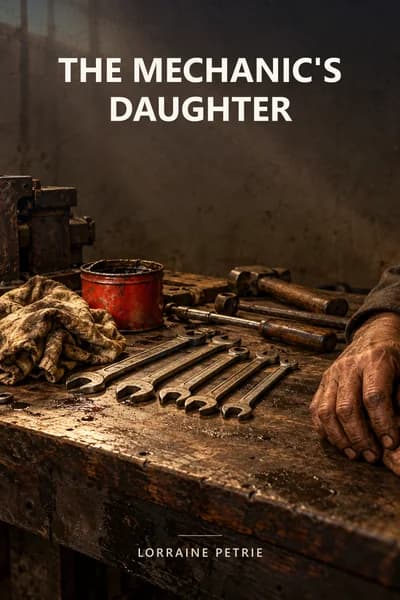
The Mechanic's Daughter — a documentary photograph of a workshop bench with worn spanners and oil-stained hands

The Mechanic's Daughter

Lorraine Petrie

The brief: a working-class memoir with 140 family photographs, a tight budget, and an author who did not want a portrait of herself on the front. Colour throughout was impossible at the price she could pay.

What we did

  • Put the work on the cover instead of the person: a documentary photograph of the bench, not the family
  • Cut 140 photographs to 48, chosen for what they add rather than who is in them
  • Grouped them into two 16-page sections so the interior prints mono throughout
  • Rebuilt 11 low-resolution scans and told her honestly which 9 could not be used
  • Costed a 150-copy family run against print on demand and set the retail price from it

What was delivered

  • Cover artwork for print and ebook
  • Print interior with two photographic sections and captions
  • A costed comparison of short-run and print-on-demand editions
  • A permissions and caption list for every image used
The Patient Operator — a brass stopwatch photographed on a dark slate surface under one hard light

The Patient Operator

Fiona Mbeki

The brief: a business book by an author with no platform, intended to be handed out at speaking events and sold online. The manuscript arrived at 94,000 words with the argument buried in chapter nine.

What we did

  • Structural edit moved the thesis to chapter one and cut the book to 54,000 words
  • Rebuilt nine frameworks as vector diagrams in one line weight, legible in mono
  • Chose hard-lit product photography over geometry, so it reads as serious next to trade titles
  • Specified the 234 × 156mm trim trade business books use, and held the page count under 200
  • Costed a 300-copy event run against print on demand at the same unit quality

What was delivered

  • Cover artwork for print, ebook and audiobook
  • Print interior with a consistent diagram system
  • Reflowable EPUB and a chapter-marked audio script
  • A bulk-run costing for events, and the layered source files
A reader settled into a sofa at home with a paperback

On numbers

Why there are no sales figures here

Every publishing site you have compared us with has a case study with a number in it. Ask yourself where that number came from.

Sales data belongs to the author and the retailers. A services company that publishes "15,000 copies sold" is either sharing a client’s private numbers or inventing them, and in our experience of reading these pages it is usually the second. There is no way for you to check either way, which is exactly why the number is there.

So these case studies describe what we did: the decisions, the constraints, the files. That is the part we are responsible for and the part you are buying. If you want to know what the work costs, our packages and prices are published, and book cover design explains how the first of these three was approached.

  • What was briefed, and what we changed about the brief
  • The constraint that shaped the project — budget, images, page count
  • Every file handed over at the end
  • No sales claims, rankings or review counts

What a case study on this site contains

Sales figures

0

Sales figures

The data model has no field for one, so nobody can quietly add it later.

Books taken apart

3

Books taken apart

One essay collection, one memoir, one business book. Each with a different constraint.

Deliverables listed each

4

Deliverables listed each

What the author actually received, itemised, so you can hold a quote to the same list.

Of files handed over

100%

Of files handed over

Source files included on every project, so no author is locked in by what we hold.

What authors say

What those authors said

Each quote is about a different book from the three above, because a cover beside a quote reads as a review of that book.

  • A food memoir with sixty photographs and a budget that could not take colour throughout. They grouped the images into two sections, costed it both ways and showed me the difference per copy. I understood the trade-off in about four minutes and chose it myself.

    Sofia Castellano

    Author of Nine Kitchens

  • Forty maps, two hundred endnotes and an index. Three other companies quoted me as though it were a novel. This one asked to see the figure list before quoting, which told me immediately they had done this kind of book before.

    Gordon Maitland

    Author of The Longest Fence

  • Every chapter ended in an exercise, and nobody could tell me how that would survive as an ebook. They rebuilt the exercises as styled text instead of pictures of worksheets, so they work on a phone and with a screen reader. I would never have known to ask for that.

    Dylan Fourie

    Author of Stop Rehearsing

Make room for your book.

From your desk to a reader’s shelf

Tell us what your book needs

Send the manuscript and the constraint you are working within — a budget, a date, a hundred photographs. We will tell you how we would approach it.